Tuesday, July 26, 2022

Volunteer fire departments need your help

Front row L to R: Heather Sampson, Stewart Smith, Robert Foreman, Shawn Sampson, Mark Logan Back row L to R: Trevor Tomilson, Stephanie Tomilson, Marc Wates, Sarah English, Dave Harder, Jim O’Neill, Anouchka O’Hara

On Wednesday night, 6 July, I climbed into bed to watch a bit of television. Then I heard a really odd sound; it sounded like a faulty water pump. I had an ‘oh my God’ moment, worried that something had gone wrong with the pump in the utility room downstairs -- the joys of country bumpkin living. It was getting louder, though I resisted the urge to get up.  Something, somewhere was pumping water. It seemed to go on forever.  My cerebral palsy brain is challenged by noise and light when I try to sleep and stay asleep, so I wear a room darkening mask. But shutting out that interminable noise was a challenge. Finally, sleep did overtake me.

Morning came and I got the dogs up and out; the puppy to their pen off the dining room and the old diva dog on the tie out line off the garage, to wander around the driveway. That’s when I saw it – the Stanley Volunteer Fire Department’s command vehicle, with light flashing. I then got on my trusty mobility scooter to go down the driveway to inquire as to what was going on. I learned there had been two structure fires, happening within hours of each other and not far away from each other. Curious.

The fire department makes use of the pond in front of my home to fill their tankers. There were numerous fills that night and I’m glad they had such ready access to water, for without it they’d not have been able to do their job.

I had a chance to learn more about the incident from my friend and volunteer fire fighter, Stewart Smith.

According to Stewart, “they spent all night on those two fires. It came in from 459 dispatch around 12:15a.m. as a single structure fire; about two hours into it there was a second structure fire, just up the road. The Departments involved were Stanley, Nashwaak Valley, Upper Miramichi, Keswick Valley and Juniper all contributing apparatus and manpower through mutual aid. It’s a tough job but one that get into your blood.”

Stewart and most of the volunteers are no longer young. The same is true within the ranks of all manner of volunteer agencies and organizations that are part of the fabric of many communities across the province, across the country. Volunteer services such as rural fire departments are vital to sustaining a quality of life that is made safer because of their presence. Complacency creeps in with losing sight of the reality that numbers of volunteers are decreasing while demands for boost in numbers is increasing.

To improve access to training to become a volunteer firefighter, courses are now available online as adjunct to in-personal sessions. More than 150 hours of training is required for certification. 

According to New Brunswick’s Justice and Public Safety Department, NB has approximately 5,000 volunteer firefighters who have taken on the arduous task of protecting the province through a range of hazardous and potentially life-altering events, from house fires and motor vehicle accidents to wildfires and medical assistance. Without them we would be less safe. Many of us are aging out of lots of roles that defined our lives within our community. That is no more evident than in the service industry, the benefits of which are shared by everyone and when their numbers are reduced, that impacts the community as a whole. 

Imagine stopping what you’re doing to rush off into the life of someone in crisis as they watch their house burning; their home, the stories of their lives up in smoke.  The reward for volunteer firefighters is knowing that they made a difference. When one joins the ranks of the volunteer firefighter, s/he’s letting their community know that they have what it takes to make a difference.

It’s important, though that we all do our part. If we heat our home with wood, it’s vital we maintain the flue with cleaning each fall season before first burning. Book your appointment today. Also important is to check appliance cords and electrical connections for other devices for wear and tear; replace as necessary to avoid a preventable tragedy. We’re ‘in it’ together, after all.

Carla MacInnis Rockwell is a freelance writer and disability rights advocate living outside Fredericton, NB with Miss Lexie, a rambunctious Maltese and Mr. Malcolm, a boisterous Havanese. She can be reached via email at Carla MacInnis Rockwell


Tuesday, July 19, 2022

Living long (and well) with disability


In the words of the inimitable Bette Davis, “old age ain’t no place for sissies.” I wholeheartedly agree! Growing old while living with challenges to daily living, such as conditions like cerebral palsy pose, requires one be of ‘strong stuff’. Internal fortitude is vital to survival of the less fit.

Those of us ‘of a certain age’ through years of several times daily physiotherapy, who did learn to walk, also learned an array of skills that paved the way to independent living. To say that I was and am fortunate is an understatement. I would not be where I am to day from a health/medical standpoint, were it not for the diligent years long commitment of my Mom. My two eldest siblings put me through my paces a time or two, accompanied by likes of Hank Williams or Connie Francis. Mom preferred the crooners like Bing Crosby, while Dad was into classical. Music, music, music made the legs go round and round til they were strong enough to stand on – putting one floppy foot in front of the other. Off I went. I’m still going!

I then began to think about a burning question. Who was/is the oldest person in Canada living with cerebral palsy, regardless of type, of which there are five – spastic, ataxic, athetoid, hypotonic, and mixed? Each type is classified by a unique set of symptoms.

Patricia Hamilton, called Teedie by everyone who knew her, was born in 1924 with severe spastic cerebral palsy. Third of 10 children, 5 boys and 5 girls, Teedie’s father, Dr. William Gordon Hamilton, was the doctor in the village of Westport, Ontario. Her mother, Caroline, was a local schoolteacher. By comparison, I’m considered much higher functioning in terms of mobility given only my legs were involved. Ms. Hamilton and I have a few things in common. Our fathers were doctors and our mothers were teachers. We grew up in in a large family; I am #7 of 5 boys and 3 girls. Today, 3 of us remain; me, an elder sister and an elder brother. Teedie’s father, like my own, accepted barter for medical services, which worked out well for us; lots of farm produce to feed a large family. Other locals provided trades skills; one fellow built a tricycle for me that allowed me to safely pedal around the main floor of our huge home on Church Street, in Bath, NB. For outside use, another built a walking frame, similar to that found in physio departments of hospitals, so I could practice walking while taking fresh air. Today, I have the lung capacity of a marathon runner.

Like Teedie’s parents, mine never considered having me institutionalized. I attended school, driven by my mother; on the occasional ‘snow day’, I still had work to do at home.

Now that I’m on ‘this side of 70’, I’ve given up doing a lot of things that require sound balance as I know my limits and respect the changes aging creates. I’m a work in progress!

Teedie lived to the ripe old age of 97, spending the last years of her life in a nursing home in Ontario. The documentary about her is an important contribution to breaking down attitudinal barriers and enhancing awareness of the needs of those aging with disability, whether in their own home or in government sponsored care.

Bernadette Rivard was born with cerebral palsy in 1931, living at home until age 31 when her care became beyond the ability of her family. Fears that she wouldn’t survive were replaced with the reality that she thrived. What is remarkable is that Bernadette lived in this nursing home for more than 50 years, making her one of the longest residents of a long term care facility in Ontario.

Though dependent on others for care, Rivard managed to leave a lasting impression on family and friends over her 83 years. She died on May 14, 2013, having lived, since 1962, at Pioneer Manor, an Ontario nursing home. She was predeceased by seven siblings.

My goal is to live well, with good eats and exercise so I can stay mentally engaged, never defined by labels. Maybe I’ll see 100 candles on a chocolate cake!

Carla MacInnis Rockwell is a freelance writer and disability rights advocate living outside Fredericton, NB with her geriatric Australian silky terrier and a rambunctious Maltese. She can be reached via email at Carla MacInnis Rockwell


Tuesday, July 5, 2022

Basic income central to pandemic recovery


I liken the COVID-19 afterlife to Baby sitting in the corner; there it sits, not going away. Variations of the virus will be present in our lives for years to come, so we must accept this new reality if we are to overcome and get on with things -- which depends on the co-operation of every single one of us.               

I believe that Universal Basic Income has a place in the equation if the playing field is to be leveled even a little bit to accommodate those most affected by the pandemic and the aftermath; housing/shelter losses, job losses, withdrawal from institutions of higher learning because of lack of funds. The list of losses is long. 

What the COVID aftermath does is shine a light on all manner of inequalities spilling out; front and center are the deficiencies in the lives of our children — they are our future, right? Why are we not doing more to ensure that they get the future they deserve — the kind the ‘haves’ don’t worry about too much because they’re already on track to a life that won’t experience a lot of worry about where the next meal is coming from, can Mom pay the rent this month? or will Dad still have a job in the fall?  Children in financial crisis, because their family lives on the edge day in and day out, worry about things young people should not have worry about.

My brain is boggled. Yes, it is! I just cannot understand how so many are stuck on the notion that a universal basic income is tantamount to paying people to do nothing. How very wrong they are.  Frankly,  it’s an insult to those who, very often through circumstances out of their control, have lived on the financial edge for years; for decades. You’ve heard the statement — most people don’t have $400 to cover an emergency. It’s true!

The single mother working two minimum wage jobs trying to keep a roof over her head and food on the table for herself and 4 kids is the one working for nothing, if we define working primarily in dollars and cents. Think about that. After all the costs of necessities of life are met there is very little left over for even one of the things most of us take for granted. Her 4 children are missing out on lots of experiences and tools that could enhance the quality of, for example, their learning life. How many children in this province do not have access to the internet let alone a computer, laptop or tablet? 

We’re too quick to make the bold statement that women (and men) who don’t work outside the home to earn money are not working, are lay-abouts, are milking the system, are abusing resources that they don’t deserve to access. That self-entitled attitude espoused by those who already ‘have’ is insulting on so many levels. It’s got to change if we have any hope of advancing the opportunities for those who need a hand up. All of us are in this together.

Our current social assistance programs essentially put recipients into a forced/government state of poverty out which there seems no climb. There’s no incentive to rise above when even basic needs are not met on a consistent basis, with the underpinnings of stress and fear driving every move.  No way to live, it’s not surprising that people living in poverty are sick, physically, emotionally and spiritually.

There have been lots of kitchen table discussions about guaranteed basic income also known as universal basic income. More and more people are coming to the conclusion that it may be the most efficient/effective way to assist those who are trapped in poverty. Fortifying their financial base will improve health and wellness which will concurrently reduce stress on the health care system. That is good medicine for all.

A report by the Parliamentary Budget Officer estimated a national guaranteed basic income would cost about $88 billion in 2022-2023. Perhaps sooner rather than later, representatives of the various branches of government will do the math on UBI and say YES to success.

Carla MacInnis Rockwell is a freelance writer and disability rights advocate living outside Fredericton, NB with her geriatric Australian silky terrier and a rambunctious Maltese. She can be reached via email at carmacrockwell@xplornet.ca

Tuesday, June 21, 2022

Cheers to Dads who do things differently


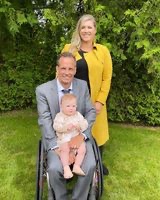
Courtney Keenan with daughter, Poppy


Father’s Day, as a day to celebrate fathers is gone for another year but the days of father, of fathering, of ‘doing the Dad thing’ continue.

For the past several decades, copious literature illustrates that the role of father has changed, has shifted dramatically. The workload of Dad has taken on a multitude of tasks often done by females – ‘women’s work’. Employment opportunities, housing, friendship connections and community involvement all contribute to growing boys into men and men into fathers – into Dads.

While there are many resources for fathers of children with disabilities, it is more difficult to find resources for fathers living with disability because we live in a culture that sometimes assumes, unconsciously and mistakenly, that people living with disability are not likely to be parents. As well, some among us may entertain Dickensian stereotypes about how one with challenges to daily living could possibly procreate let alone provide for children once they are born.

Fathers, like mothers, are pillars in the development of a child's emotional well-being, with children looking to their fathers, to Dad, to provide a feeling of security, both physical and emotional. It’s exceedingly challenging for single mothers, women without a partner, whether by design or circumstance, to fulfill the role of Dad in a way that’s going to be impactful in the long term. It’s an emotional roller coaster and often puts too much pressure on women who are already spreading thin each day’s allotment of hours to ‘get it all done’.

More than ever, community leaders must step up and organize schemes to address these cracks in the landscape of community life that diminishes how those who struggle are coping as stressors mount. Post-COVID lives are forever changed.

Fathering a child is easy for many men but being a Dad takes a lifetime of commitment to instilling in a child the values that will ensure physical, emotional and mental safety within the home and within the community. If there is no active male presence in the home, many single mothers will network with groups within the community with men who possess the requisite care and compassion to step up to interact with their child.

They've got their dancin' shoes on

Fathers, Dad, men not only influence who we are inside, but how we have relationships with people as we grow. The way a father treats his child will influence what that child looks for in other people. Friends, lovers, and spouses will all be chosen based on how the child perceived the meaning of the relationship with their own.

Unlike girls, who model their relationships with others based on their father’s character, boys model themselves after their father’s character. Boys will seek approval from their fathers from a very young age. As human beings, we grow up by imitating the behavior of those around us; that’s how we learn to function in the world. If a father is caring and treats people with respect, the young boy will grow up much the same. When a father is absent, young boys look to other male figures to set the “rules” for how to behave and survive in the world.

Throughout history, discrimination against parents with disability is all too common and the number of such parents who push back, victimized by such overt abuse, needs to grow. It’s time they were heard and seen as valuable contributions to family life, to community life. So long as ‘the card holders’ and the ‘purse string holders’ continue to be obstacles, little will change. That being so, it’s incumbent on each and every person in the community to examine their misguided view of what it means to be a Dad, a father, a parent. We live what we learn so if we’re holding on to antiquated views advanced by generations, then we do ourselves and our families and our communities a huge disservice. Government systems of child protection need to change and get with the times by developing working relationships with those whose parenting style differs from the norm.

Being a Dad should be held up as a privilege, not a right; a child is not a piece of property. Father and child relationships are mutually nurturing. Cheers to Dads who do it differently.

Courtney, Courtenay and Poppy


Carla MacInnis Rockwell is a freelance writer and disability rights advocate living outside Fredericton,  NB with Miss Lexie, a rambunctious Maltese and Mr. Malcolm, a boisterous Havanese. She can be reached via email at carmacrockwell@xplornet.ca


Monday, June 6, 2022

Disabilities don't need to hold back Dads


As Father’s Day approaches, I am reminded of my own father who, in the early 50s, began his medical practice in Bath, Carleton County. Our family grew to number 8 children; I am number 7, the ‘differently able’ one. Though he never intended for it to happen, Dad treated me more like a patient than a daughter. Perhaps that was inevitable, given his background and training and the realities of my situation from birth to date. Dad died in 2008, never the Father Knows Best kind of father, dispensing words of wisdom to his children. In fact, truth be told, he spent more time with other people’s children than he did with us. Nature of the beast growing a medical practice in a new place where the ‘rules of the road’ were different from the place where he was raised and educated.

    Fathers who are physically and emotionally present in the lives of their children, who accept, nurture and encourage them, make a huge difference. Physically, emotionally or economically absent fathers leave a gaping hole in the lives of their progeny, though ‘father hunger’ can be fed by other significant males in the world of a child – a teacher, a pastor, the school’s soccer coach, or a few local businessmen. All can have a role in nurturing fatherless children and contribute to them growing into self-confident, community minded adults.

    Being a father is about conceiving a child; being a DAD is so much more. Being a girl Dad! Now, that’s something else entirely.

    Men who live with challenges to daily living, notably the inability to walk and to run, to engage in rough and tumble games, to teach children to play ball, to golf, to skate and to swim, will often have feelings of guilt and uncertainty about whether they could be a Dad, should be a Dad. To them I say, go for it! There are so many things that a differently able Dad can teach his children without actually doing anything that involves physicality, unless making funny clown faces count. Children are like sponges, observing the goings on in their environments so it doesn’t take them long to fine tune a set of skills that allow them to settle in to the day to day with a parent who does things in a different way.

    Courtney Keenan became a first time Dad to Poppy last year. I’ve not yet met him, but I grew up across the road from and went to school with his Dad, Gary. Clan Keenan numbered 13 children, with many of theirs being of similar age to the MacInnis 8. We grew up at a time when inclusion was a given so I and those like me were part of the community with no thought to what we could or could not do. We simply went along as best we were able.

Courtney and his siblings grew up in small town New Brunswick as well, but at a time when there was greater access to technology and with that, a different type of education and opportunity than was my experience.

As a young man, Courtney sustained a catastrophic life altering spinal cord injury which, in an instant, derailed any sort of life plan he was nurturing at the time. His life today, in spite of C5 quadriplegia, speaks to the success he’s achieved in realizing many of his dreams; being a husband and father are top of his list. I’ve seen photos of him with his daughter and the joy is palpable.


Courtney Keenan and daughter, Poppy

    Men and women with SCI who become Moms and Dads may require certain supports to daily living not required by the uprightly mobile and able-bodied but that in no way diminishes their effectiveness as loving parents, able to meet the demands of child rearing, which is no easy task at the best of times. In fact, parenting from a wheelchair is a life lesson with staying power. Knowing that allows wheelie Dads and Moms to lighten up and loosen up and enjoy the journey with their child, from infancy to adulthood. Hang on for the ride through the teen years. 

    Courtney himself said it best: "People want to know what it’s like to be a Dad with a disability but what does it mean to be an able-bodied Dad? Is it not about loving beyond & giving of yourself? Does my disability diminish the joy her smile brings, the warmth I feel when she holds one of my fingers or the hopes I have for her future? As any father can attest, there are no words to describe how the love of a child makes you feel. I am a father & husband before anything else, especially disabled."

    Happy Father’s Day to all the folks fulfilling that role.

Carla MacInnis Rockwell is a freelance writer and disability rights advocate living outside Fredericton, NB with Miss Lexie, a rambunctious Maltese and Mr. Malcolm, a boisterous Havanese. She can be reached via email at carmacrockwell@xplornet.ca

Wednesday, May 25, 2022

Sidewalk repair is a public safety issue


                 Photo: Corinne Fitzherbert/The Victoria Star

City sidewalks, busy sidewalks. Dressed in seasonal cracks.

It’s most assuredly not the most wonderful time of the year for men and women, boys and girls, even cats and dogs, as they navigate city streets that are plagued with gaping cracks, huge chunks of sidewalk missing, with portions of sidewalk squares actually lifted, posing a stumble and tumble risk. A friend recently fell victim to Fredericton’s appalling sidewalks, fortunate not to have sustained a more serious injury than scraped hands and knee. Ouch.

Here's the sidewalk upon which my friend took her tumble. If you look around at 'landmarks', you'll figure out where it is.


Scene of the 'great tumble' - Fredericton sidewalk

Scarily, a person whether young or old, could become incapacitated for several weeks just walking to the corner store. That’s not right. That’s not okay.

It’s especially not okay when we think about those who live with daily challenges to mobility, requiring devices like canes or crutches to move about on city streets. Disabilities like cerebral palsy, for those who are able to move along without assistive aids pose particular challenges as they make their way along sidewalks riddled with cracks, dips and lifts.

Our lives are a balancing act at the best of times and a crutch or cane tip caught in a crack can unceremoniously take down those easily put off balance. Very often, in an effort to save themselves, the falling person does more harm, with the twisting motion to slow the descent. With that, a hip may break.

As well, given the state of disrepair of far too many sidewalks, the very old who still enjoy a daily walk are one serious fall away from loss of independent living to full time residency in a nursing home. Ignoring that particular problem will not make it go away. We all have a right to freedom of movement with safety within our communities and if the sidewalks are in a chronic state of disrepair that’s not only shameful, it’s criminal. It’s up to everyone to speak up. Grumbling about the state of city streets and walkways doesn’t get them repaired. It just makes people more angry. If you see a problem, speak up. That, my friends, is your job as a fully-formed, functioning human being. No shirking!

Ensuring that citizens are able to enjoy the places where they live requires that sidewalks and roads be safe. After all, tax payers have the expectation that their dollars are working for them, not just for the people ‘at the top’ who administer doling out the funds set aside for routine and necessary sidewalk maintenance; accountability is critical. It is the right of all to expect that when issues of safety are brought up before the ‘city fathers’ that action will be taken. Waiting for months, a year, two years, is wrong and should never be tolerated. Passing the buck should not be the ‘gold standard’. If people in power really don’t know what they are doing, they should find their spine, speak up and suggest someone better suited to the job be found. It’s the right thing to do.

In our current post-COVID climate, I’ll still be wearing a mask in public, as I believe it’s important to ensure the safety of all, being particularly respectful to those who require extra care and attention. By the same token, city planners must be respectful in these post-COVID times of the realities imposed by COVID’s financial costs. Many people have had to forego driving their cars because of costs; they’re walking or using city transit. In walking, they need to be and feel safe. The streets where they live must not be the thing in their life that takes them down and out.

Aging in place is the ideal for seniors, married, widowed or otherwise; advanced age affects physical and emotional health in ways not appreciated by the younger generations and the cost of care in settings outside the home have shot through the proverbial roof, putting quality care out of reach for so many.

A scraped knee or elbow, sustained from stumbling on poorly maintained sidewalks and streets is no small thing for many folks over 40. We don’t bounce. Many of us break. Some of us break in multiple places in a single falling event. Perhaps rubberized sidewalks is the answer. Hmm.

Carla MacInnis Rockwell is a freelance writer and disability rights advocate living outside Fredericton, NB with Miss Lexie, a rambunctious Maltese and Mr. Malcolm, a boisterous Havanese. She can be reached via email at carmacrockwell@xplornet.ca


Tuesday, May 10, 2022

People and pets on the move. Where to go?


With the warmer weather comes change of place for lots of folks, university students on the move, empty nesters downsizing, seniors and the very old moving from family homes that have been part of the familiar fabric of their lives for decades.

For that group, what to keep and take to a much smaller place, what to give away, and what to sell are ongoing concerns. Packing up lives, however lived, whether financially fragile or able to meet all daily needs without concern is a challenge at the best of times. Ultimately, people are people regardless of economic circumstance and pets figure into the equation of their lives.

Yet there are forces beyond their control at work, unwittingly taking a hammer to that sacred dynamic; a sad commentary on our society but reality being what it is, those who provide accommodations through the rental process have properties to protect and have a ‘no pet’ clause. However, not all cats and dogs cause damage. Let’s be clear about that. The companion animal that has grown up in a home with compassionate care is part of the family. How many among us get birthday or Christmas presents for our pets; take the family dog out for ice cream in the summer?

In fact, in the absence of two-legged family members, whether near or far, the most significant piece of their lives is the family pet. In some cases, there may be more than one. A couple of dogs or a couple of cats, or one of each.

At law, pets are considered property, not having the same rights ascribed to their human caregivers/companions and can be disposed of at will, when they become inconvenient or have outlived their ‘usefulness’; rehomed, surrendered to animal shelters or, in the case of dogs, breed specific rescue organizations.

Those who truly love and value their pets for the companionship and unconditional love they provide will never view them as property to be disposed of at will. Thus, the tragedy for those living on the fringes, both financially and physically, is having to make the decision to ‘get rid’ of their resident ‘emotional support system’.

Rents across the country have skyrocketed, pushing out those of limited means though many may have access to government subsidy to support their housing. Landlords must come to understand that subsidized housing is not a reflection of character of potential tenant. Subsidized housing, particularly for seniors, is a mechanism that allows them to live independently for as long as they can. Staying out of the nursing home care stream is cost saving across the board. Institutional care is expensive and very often impersonal though there are many nursing homes and seniors housing across the province staffed by remarkable, caring people who are hands on and present for the physical and emotional needs of those who are in need of such intervention.

Sadly, though, many seniors will often remain in unsafe situations if it means they can keep their pets. Exploitation by family members is a sad reality of the human condition. If living with an abusive adult child means a senior can keep their companion animal, they’ll do it; sometimes to their detriment and to the detriment of their pet. Abuse takes many forms and animals often becomes a pawn in a push pull, as the one with ‘the power’ diminishes the will and resolve of the fragile senior. If you see abuse, report it.

Research shows seniors are healthier and have a greater sense of well-being if they have pets, yet balancing the desires of pet-owners with those of non-pet owners isn't an easy one. Can common ground be found? I’m of the view that it can be.

New apartment and condo developments could assign a certain number of units to tenants with pets; perhaps on one side of the complex, a block of units for ‘pet people, with escape-proofing built into the design; balconies with fencing. Ingenuity gets the job done.

Long term tenancy is a plus for landlords when they rent to ‘pet people’; no yearly repairs between tenants. Saving dollars and cents makes sense all around. Purrfection.

Carla MacInnis Rockwell is a freelance writer and disability rights advocate living outside Fredericton, NB with Miss Lexie, a rambunctious Maltese and Mr. Malcolm, a boisterous Havanese. She can be reached via email at carmacrockwell@xplornet.ca